INTRODUCTION To SmartBooks
(AIDS II SmartBook Version, July, 1993)
By Danny Kopec, Ph.D.
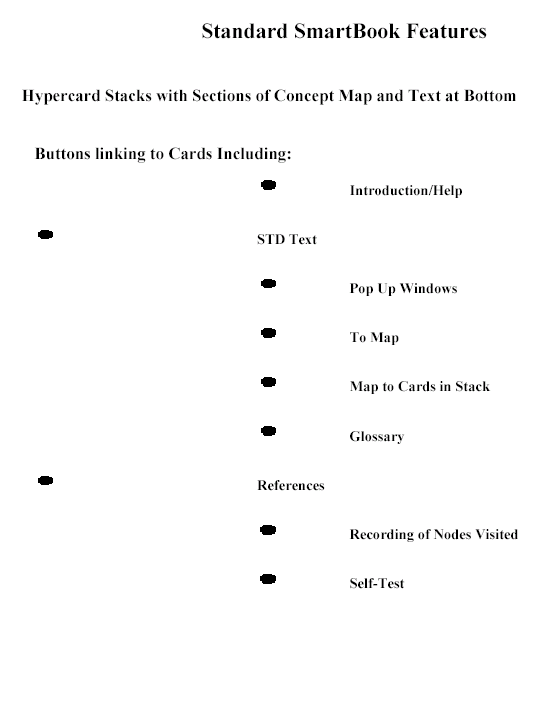
What you are about to participate in is a rather new technology. We call it a SmartBook™ because we believe it has a number of advantages over the standard published/printed textbooks. First of all it is more flexible than a standard textbook. That is, you, the user can move through it in many ways. All information is represented in two forms: graphically and in prose (textually). More information about the knowledge in the areas we are representing can be obtained by traversing from screen to screen by objects in graphs (called concept maps) or by clicking on certain keywords for further explanations.
Concept maps are a graphical form of knowledge representation whereby all the important information in a domain can be embedded in nodes (rectangular buttons or nodes in this system) and arcs (the lines connecting nodes).
At any time during the use of the system a user can see how he/she arrived at where they are (the path taken through the smart book) and where it can lead to. This is indicated by pictorial representation on the top of each card illustrating how the shaded circle (node) was reached and what circle(s) (nodes) it can lead to. Arrows without circles attached to them represent nodes which exist but are not shown in order to avoid cluttering the screen. These nodes can be found on subsequent screens. "General Text" refers to the node which is currently shaded in a graph on a visible screen.
SMART BOOKS
Most people would probably agree that formal learning over the last centuries has been achieved through books. Books consist of words which comprise textual information or photos which comprise graphical information.
A well-written and well-structured book is naturally an excellent source of information on a subject for a student to learn from. Books tend to be complete and sequential in their presentation of material. There is also an implicit hierarchical structure for the knowledge in most books which attempt to present learning material. This structure entails the presentation of material in a top-down form. That is, the general overview of a subject is presented first and then details on specific relevant topics or methods will follow. A good text will have all the important subject information as well as a table of contents and index detailed enough to direct the reader as to where to find information on any topic of interest covered in the book. Key words may also be highlighted in some way. However, lacking in any text is a flexibility in the order of presentation of information. This is due to the very static nature of this form of knowledge representation, the style and content being rigid and unchangeable once a book is published.
The primary advantage of a SmartBook is flexibility. That is, it can be used in many ways. The order in which material to be learned is presented is the choice of the user. All information is represented in two forms: graphically and textually. Graphical information has been derived from a form of knowledge representation called
concept maps. The structure of these maps can embellish the knowledge of experts in a domain. Typically any node (oval or button) on a screen can be "clicked" to proceed to the next screen with a new map segment and more information. The key to a Smart Book's flexibility is that one can move in many directions via the nodes and arcs in a graph. Concepts in nodes are connected by arcs. Importantly, at all times the user can quickly determine how the current node was reached and what are the possibilities for proceeding from the current node. Textual information is always presented in a brief, compact and clear form.In essence, the SmartBook, represents a road map through the knowledge base of STD's. The system has been developed in Hypercard, the Macintosh hypermedia system which enables interface to many forms of information. Transparency in form and function is fundamental to the smart book. In addition to existing pop up windows, there is the potential for linking to a glossary of terms, synonyms for key words, a retrace facility, expert advice, and video-disk presentation of graphical information. As any good knowledge base, it is easy to modify, expand, and refine. The Smart Book is viewed as an important stepping stone to ultimate goal of building an Intelligent Tutoring System for educating about sexually transmitted diseases.
SmartBooks vs.Standard Texts
Smart Book
Standard TextAdvantages
Concept Map Approach vs. Author(s)' Conceptual
Multiple Expert Knowledge Knowledge
Flexible Order of Use vs. Rigid, Fixed Order
Any Combination of vs. Mostly Textual Knowledge
Graphical and Textual
Knowledge
Virtually Unlimited Size vs. Size Limited by Publisher
Authoring System
Easy to Update/Revise vs. Must Republish
Expand
Automatic testing, recording, and scoring vs. Manual, Memory Work
of Material Read
Disadvantage
Cannot See Whole Work vs. Can Hold Entire Work
at Once "In Hand"
The AIDS SmartBook
The main thing we want you to remember is that YOU CANNOT HURT THE COMPUTER! Think of the SmartBook as you would any book. To turn the pages all you have to do is "click" your mouse on the desired topic. Don't be afraid to move around -- that is the greatest advantage the SmartBook offers: flexibility.
What you are about to participate in is a rather new technology. We call it a "SmartBook" ™ because we believe that it has a number of advantages over standard published/printed textbooks. First of all it is more flexible than a standard textbook. That is, you, the user, can move through it in many ways. All the information is represented in two forms: graphically and textually (in prose) at the bottom of each screen (called a card). It is also more easy to revise and update than a standard textbook.
More information on the topic areas presented in the AIDS SmartBook can be obtained by clicking on certain keywords (in ovals called buttons) that will move you from screen to screen. The buttons on the top half of each screen are linked with arcs comprising sections of a graphical representation (called concept maps) Concept maps are a graphical form of knowledge representation whereby all the important information in a domain can be embedded in nodes (ovals filled with words, which in this system function as buttons) and arcs (the lines conceptually connecting nodes).
At any time during the use of the system a user can see how he/she arrived at where he/she is (the path taken through the SmartBook) and where it can lead to by clicking on a rectangular button called TO MAP. This presents the entire AIDS concept map, with the exception of nodes at the extremities of the map which appear as "pop-up windows" on some cards.
Now you should be ready to
PROCEED by DOUBLE-CLICKING on AIDS II SmartBook.
System Requirements
The AIDS SmartBook is developed and designed to run on Hypercard version 2.0, or later installed on any Macintosh Plus, SE, Classic, LC, II, IIcx, etc. with operating on Macintosh system version 6.0 or later installed. It will run on Hypercard 1.0 as well although at times it may "lock up". For satisfactory performance your computer must have at least 1MB of RAM .
Background and Credits
This SmartBook has been developed through an interdisciplinary effort involving a number of faculty, staff, and students at the University of Maine. The AIDS concept map was initially designed by Michael Brody (Ph.D., education) and doctors at the University of Maine's Cutler Health Center during the spring of 1988. The first AIDS SmartBook using Hypercard 1.2 was designed and implemented by Chao Cheng Shi (MSc. Computer Science) , Carol Wood (Ed.D., RN) and Danny Kopec (Ph.D., machine intelligence) in April, 1989. It underwent considerable testing, evaluation, and criticism from nursing students. During the fall of 1989 the AIDS concept map was substantially revised and simplified by Peter Millard (MD). Shi completed a new version of the SmartBook more or less approximating its current state by February, 1990. Since that time it has undergone further evaluation and testing by Carol Wood with student subjects.
Numerous design improvements, refinements and updates have been effected by Steve Bennett, Mark Jackson (MD) and Danny Kopec leading to the first completed version completed in December, 1992.
This new version of the AIDS SmartBook called the AIDS II SmartBook, focusing on HIV and AIDS as two distinct phases of the disease, has been designed and implemented exclusively by Steve Bennett, Mark Jackson, and Danny Kopec.
What is New in the AIDS II SmartBook
The AIDS II SmartBook has a number of features which we feel are improvements over the first version. These are:
1) The AIDS concept map (the graphical representation of what experts have determined to be the most important concepts related to a subject area) has been entirely revised. It now focuses on two major subject areas, HIV and AIDS, on an equal par.
2) All the textual information has been completely revised and updated (as of April, 1993).
3) On the
4) There are optional
Self Quiz and Final Exam features which allow the learner to review his/her learning about any topic area. At the end of the Final Exam the learner's overall score as well as score by topic area is provided.5) Screen style has been modernized keeping in step with improvements in the application software.
USER NOTES:
1. The order in which you use the AIDS II SmartBook is entirely up to the user. However, past experience has demonstrated that people prefer to use and learn from the SmartBooks following the nodes (buttons) on the
HIV/AIDS concept map (arrived at by double-clicking TO MAP) in a clockwise order.2. On the optional Self Quizzes and Final Exam the thickened black radio oval around the choice
"FALSE" has no suggestive meaning.3. The AIDS epidemic is a worldwide problem. The information about this deadly disease is constantly changing. We have done our best to try to keep up with the most current information and present it in a form which we believe is most useful to the learner.
HELP
To move around in the AIDS SmartBook just click the mouse on a topic button (one of the ovals filled with words) on the upper half of the card. These buttons comprise the portion of the AIDS SmartBook map relevant to the currant topic. When you arrive at the topic card that you have picked, the topic name will be in a shaded oval (the current card topic button) in the middle area of the upper half of the screen.
Clicking the current card topic button will not do anything. The topic card you came from is represented by the topic name in the oval to the left of the current card topic button. You can click on that button to move to the previous card in the SmartBook map. Buttons to the right of the topic button can do one of two things: 1) they can take you to a card that has information on that topic or 2) they can "pop-up" text fields (called pop-up windows) on the current card which describe the topic clicked on. You can close the window by either clicking on the window itself (the box) or clicking any button.
The rounded rectangles that you see on the bottom of each screen are also called buttons. At any time you may move your mouse to one of these buttons and click on it. A description of the standard buttons in the AIDS SmartBook follows.
1. Clicking the
AIDS Start button will get you started.2. The
START button will bring you back to the beginning of the stack.3. The
TO MAP button will take you to a map that uses buttons to represent the structure of this SmartBook (called a concept map). The button which represents the card you came from will be shaded black on the concept map. Click on any of the concept map topic buttons and you will go directly to that card in the SmartBook.4. The
GLOSSARY button will take you to the index card in the AIDS Glossary stack. Listed on this card are all the words that appear in the AIDS glossary. Click on one of those words and a card will appear with the word you have picked at the top and the definition at the bottom.5. Clicking on the
REFERENCES button will list the sources of information which have been used to develop the AIDS SmartBook.6. Clicking on the
HELP button will bring you to the HELP Card.7. Clicking on the
INTRO button will take you to the introductory card which describes the AIDS SmartBook and provides some background .8. Clicking on the
QUIT button will give you the option to exit the AIDS SmartBook.
Acquired Immune Deficiency Syndrome (AIDS)
The first cases of AIDS were diagnosed in the United States in l98l, yet the seriousness of this disease, combined with its rapid growth, have led to a public health crisis unparalleled in modern times. By the end of l985, over l5,000 cases of AIDS had been reported. By January l987, over 30,000 cases had been reported to Public Health authorities in this country. Current extimates as to how many people are infected range from 1.5 to 2 million. Worldwide, it is estimated that 10 to 15 million people are infected with the AIDS virus. Estimates on how many of those people will develop AIDS range from 40% to 100%. In the United States AIDS cases have been found primarily in one of three groups: male homosexuals, intravenous drug users, and hemophiliacs. However the disease is also rapidly spreading amongst the heterosexual popolation. AIDS is a sexually transmitted disease which is reportable to the Center for Disease Control (CDC). The CDC reports that "the actual case-fatality ratio approaches 100% within 5 years after diagnosis of AIDS".
Organism
Acquired immunodeficiency Syndrome (AIDS) is caused by a retrovirus Human T-cell Lymphotrophic virus, type III. AIDS is the disease which may result after a human is infected with the Human Immunodeficiency Virus (HIV). The virus leading to AIDS has been referred to by several names, and is currently referred to most commonly as HIV. Other names are HTLV-III, LAV, and ARV. A virus is a type of organism that lives and reproduces inside a living cell, leaving the cell when the cell dies, or "explodes" with the many viruses that have reproduced inside that cell. The viruses then go on to invade another living cell, when available, to continue their life cycle.
Transmission
AIDS is most commonly passed from person to person through sexual contact as are other sexually transmissible diseases. The phrase, "exchange of body fluids" is often used to describe the way AIDS is transmitted. AIDS appears to be transmitted primarily through exposure to infected semen or blood, through vaginal or cervical secretions, and possibly urine and feces. Although the virus has been isolated in saliva and tears, there is no evidence that AIDS is spread through these fluids during casual contact. There is some concern that saliva might be capable of transmitting the virus during intimate oral-genital contact.
The second most common way that AIDS is spread is through blood-to-blood transmission. Currently, the major mode of blood-to-blood transmission is the sharing of needles by intravenous (IV) drug users. Earlier in the course of the epidemic, there was a small number of cases in which AIDS was transmitted through transfusion of blood or blood products. Since the approval of tests for screening donated blood in March of l985, this concern has been practically eliminated. Since the incubation period for AIDS can be anywhere from a few months to more than 12 years, more cases may emerge from blood transfusions done before the tests were available.
Because needles used at blood collection sites are never reused, there has never been any danger that anyone can contract AIDS from donating blood. AIDS can also be transmitted from mother to infant if a woman has the virus when she is pregnant or during breastfeeding.
Due to the relative fragility of the virus causing AIDS, it cannot be passed from an infected person through casual contact. AIDS is not spread through such activities as working near a person with AIDS, eating food that an infected person has prepared, touching things that a person with AIDS has touched, or sharing toilet facilities with a person who has AIDS.
There has been no confirmed case of transmission of HIV by any household, school, or other casual contact. The US Public Health Service states that there is no risk created by living in the same place as an infected person; caring for an AIDS patient, eating food handled by an infected person, being coughed or sneezed upon by an infected person, casual kissing, or swimming in a pool with an infected person.
Host
The host can be either male or female. In terms of who is most likely to harbor the virus leading to AIDS, there are several groups who are at increased risk, and the male is the predominant gender represented in two of those groups. Homosexuals or bisexuals who practice anal intercourse are the most prevalent risk category, and males will necessarily represent this group. Intravenous drug abusers may be either male or female, however most of the IV drug abusers who are infected are male. Female partners of bisexual men who practice anal intercourse are at increased risk, as are female partners of IV drug abusers who share needles with an HIV infected individual. Thus, in these categories the male is more likely to be the vector of the disease. The number of women with AIDS is increasing as the infection spreads into the heterosexual population, thus there are more infants being born to infected mothers.
Signs and Symptoms
Some people who are exposed will develop antibodies to the virus, remain healthy and have no symptoms of AIDS. The long term effect of infection on this group is unknown.
The symptoms which are listed here are commonly seen with HIV infections, but are seen in many other illnesses as well. With HIV infections, however, these symptoms may last for months or keep coming back, and cannot be accounted for by the presence of another illness or infection.
. rapid weight loss for no apparent reason,
. recurring fever or night sweats,
. profound and unexplained fatigue,
. swollen lymph glands in the armpits, groin, or neck,
. diarrhea that lasts for more than a week,
. white spots or unusual blemishes on the tongue, in the mouth, or in the throat,
. memory loss, depression and other neurological disorders.
Yet another group of those infected with HIV will develop AIDS, indicated by specific, life-threatening diseases such as Pneumocystis carinii pneumonia or Kaposi's sarcoma. PCP is characterized by a persistent dry cough or shortness of breath not due to allergies or cigarette smoking. Symptoms of KS may be the recent appearance of pink or purple blotches on or under the skin or inside the mouth, nose, or eyelids.
It may take anywhere from a few months to several years or more after initial infection with HIV for AIDS or ARC to develop.
Diagnosis
AIDS is diagnosed by finding one or more life-threatening illnesses that would not be found in a person with a healthy immune system. These illnesses, such as PCP and KS can only be diagnosed by a physician who performs certain bypes of tests based on individual symptoms. There is no single, simple test for AIDS. There is a blood test, that is very useful in AIDS research, and for screening donated blood for possible contamination with the AIDS virus. The blood test detects antibodies to the virus that causes AIDS. A positive test does not mean that a person has AIDS. It means that they are infected with the virus that causes AIDS and should assume that they can infect others with whom they have sexual contact.
A person is identified as infected with HIV when a swquence of tests, starting with repeated enzyme immunoassays (EIA) and including a Western blot or similar, more specific assay, are repeatedly reactive. Persons infected with HIV usually develop antibody against the virus within 6 to 12 weeks after infection.
The sensitivity of the currently licensed EIA tests is approximately 99% when they are performed under optimal laboratory conditions on serum specifens from persons infected for at least 12 weeks. The probability of a false-negative test is remote except during the first several weeks after infection, before detectable antibody is present. The testing sequence of a repeatedly reactive EIA and a positive Western blot test is highly predictive of HIV infection, even in a population with a low prevalence of infection.
Treatment
At this time, there is no cure for AIDS. Treatment consists of treating any secondary infections as effectively as possible, as such infections will become more common as the immune system deficiency becomes more pronounced. Medical science has not found a way to destroy the virus and bring the immune system back to normal. Some current attempts at therapy focus on strengthening the immune system, making the infected host more resistent to infection by building on natural defenses. Some of the various infections that a person with AIDS or ARC might have can be treated, so they may enjoy periods of reasonably good health. However, it appears that, eventually, the protective immune system is destroyed, the body is overwhelmed by infections, and the person dies.
Worldwide, research is underway to find both a cure and a vaccine for AIDS. Public health officials in the United States have declared it the nation's "number one health priority" .
Prevention
Basically, prevention of AIDS is accomplished by avoiding all exchange of body fluids such as semen, vaginal secretions, blood, urine, or feces. Avoiding contact of such body fluids with an infected person would prevent the transmission of the infecting virus. Research indicates that anal intercourse is particularly dangerous since the anus may tear, creating an entry site for viral infection , after semen is released from an infected partner. Vaginal intercourse is also a method of transmitting the disease, both from an infected male via the semen, and from an infected female via vaginal secretions, or menstrual fluid. The degree of risk with oral sex and other sexual practices involving the exchange of body fluids is not well documented. To be on the safe side, one should assume that transmission of the disease is also possible by these routes.
Condoms provide excellent protection when properly used to prevent the exchange of body fluids. Sexual contact with one infected person puts you at high risk. It is important to know if a partner is at risk or has had other sexual partners who may have been at risk for AIDS. Choose sexual partners very carefully and make sure they do the same. Talk to potential sexual partners about concerns.
Attempts at prevention will be enhanced when those who are at higher risk seek appropriate screening, and act on the results of testing with responsibility toward others. Those who think they may be at increased risk of infection, either because of their own sexual or drug practices or the practices of any prior partner, should request screening for AIDS. Anyone who received a blood transfusion between the years of l977 and l98l should also request screening. Anyone in a higher risk category, whether screened for AIDS or not, should not engage in any practices which will put another person at risk (for example, intercourse without using a condom).
If you are not a member of a high risk group, your chances of becoming infected with HIV are statistically lowered. However, since AIDS can be transmitted through sexual contact, even persons in low risk groups shoulc exercise caution. The precautions you can take are similar to those taken to avoid other sexually transmitted diseases.
For Further Reference
Bosworth, K. & Gustafson, D.H. (1991). CHESS: Providing Decision Support for Reducing Health Risk Behavior and Improving Access to Health Services. INTERFACES 21(3), May-June, 93-104.
Cohn, A. (1989). Virology, immunology, and natural history of HIV infection, Journal of Nurse-Midwifery, 34(5).
Cohn, S. D. (1989). HIV seropositivity-legal issues for patient and nurse-midwife, Journal of Nurse-Midwifery, 34(5).
DeFerrari, E., & Hopkins, J. (1989). Counseling women regarding high risk behaviors associated with HIV infection, Journal of Nurse- Midwifery, 34(5).
Denser, J.L. (1992). AIDS and the Heterosexual, J.L. Denser, Inc., Silver Spring, Maryland.
Droegemueller, W., Herbst, A. L., Mishell, D. R., & Stenchever, M. A.
(1987). Comprehensive Gynecology, C.V. Mosby Co., St. Louis.
Fang, H., Conner, R.F., & Villareal, L. (1991). The Biology of AIDS. (2nd edition) Jones and Barlett Publishers, Boston.
Fekety, S. E. (1989). Managing the HIV positive patient and her newborn in a CNM service, Journal of Nurse-Midwifery, 34(5).
Friedman, E. A., Borten, M., & Chapin, D. S. (1988). Gynecological Decision Making, B.C. Decker, Inc., Toronto.
Faro, S. (1985). Diagnosis and Management of Female Pelvic Infections in Primary Care Medicine, Williams and Wilkins, Baltimore, Maryland.
Gensheimer, K. F. (1987). Questions and Answers about Acquired Immune Deficiency Syndrome (Aids). Maine Department of Human Services, Bureau of Health, Division of Disease Control.
Hodges, L. C., & Poteet, G. W. (1988). The tragedy of Aids: A new trial for nursing education. Nursing and Health Care, 9(9), 565-568.
Holman, S. (1989). The epidemiology and transmission of HIV infection in women: Considerations for nurse-midwives, Journal of Nurse-Midwifery, 34(5).
Kopec, D., Brody, M., Shi, C., and Wood, C. (1992). Towards an intelligent tutoring system with application to sexually transmitted diseases. In Kopec, D. and Thompson, R.B., (eds.) Artificial Intelligence and Intelligent Tutoring Systems: knowledge-based systems for learning and teaching. Ellis Horwood Publishers: Chichester, England.
Kurth, A., & Hutchison, M. (1989). A context for human immunodeficiency virus (HIV) testing in pregnancy, Journal of Nurse-Midwifery, 34(5).
Libman, H, Witzburg, R.A., Clinical manual for care of the adult patient with HIV, Debt of medicine, 1990, Boston City Hospital.
Libman, H, Witzburg, R.A., Clinical manual for care of the adult patient with HIV, Debt of medicine, 1991, Boston City Hospital.
Marion, R. W., Wiznia, A. A., Hutcheon, R. G., & Rubinstein, A. (1986). Human t-cell lymphotropic virus type III (HTLV-III) embryopathy. American Journal of Disease of Childhood, 140, 638-640.
Monif, G. R. (1982). Infections Diseases in Obstetrics and Gynecology, (3rd ed.), Infections Disease, Inc., Gainesville, Florida.
Quilligan, E. J. (1983). Current Therapy in Obstetrics and Gynecology 2. W.B. Saunders Co., Philadelphia.
Stine, Gerald (1993). Acquired Immune Deficiency Syndrome: biological, medical, social and legal issues. Prentice Hall Publishers, Englewood Cliffs, N.J.
Thomas, C. L. (1981). Taber's Cyclopedic Medical Dictionary, (14th ed.), F. A. Davis Co., Philadelphia.
Zenilman, J.M, Erickson, B, Fox, R. et. al. (1992). Effect of HIV Posttest Counseling on STD Incidence. JAMA, Feb. 12, 267(6), 843-46.
UM Aids Policy (1989), University of Maine, Orono, Maine.
Recommendations for prevention of HIV transmission in health-care settings (1987). Morbidity and Mortality Weekly Report, 36(25), Center for Disease Control, Atlanta.
Aids Guidelines for Schools of Nursing (1988). National League for Nursing.
CREDITS
The AIDS SmartBooks was Developed by STDs/Net Group at the University of Maine
Mark Jackson, MD Director Cutler Health Center
Danny Kopec, Assistant Professor, Dept. of Computer Science**
Peter Millard, MD Cutler Health Center
Carol Wood, Associate Professor, School of Nursing
Steve Bennett, Graduate Student, Dept. of Computer Science
ChaoCheng Shi, Graduate Student, Dept. of Computer Science
Michael Brody, Assistant Professor, School of Education*
John Ostuni, Dept. of Computer Science
** Presently Visiting Associate Professor, Carleton University.
* Now Associate Director, Project WET, Bozeman, Montana.